

It submits a real review
Codaban doesn’t leave a pile of comments and let you work out what it thought. It submits an actual review on the pull request, with the same three outcomes any of your teammates has: Approve Request changes Comment It appears in the PR’s review list next to the humans, attributed to the bot account —codaban[bot] on GitHub, your bot user on Forgejo.
There is no silent pass. A clean run still gets a written verdict saying so,
rather than a green tick you have to interpret.
Making it blocking
By default a review is advice, and your existing branch protection decides what it’s worth. On GitHub you can make it a gate. Codaban writes acodaban/review commit status on every run — “Review in
progress”, then complete. Mark that check required in the branch’s
protection rules and the PR cannot merge until Codaban has reviewed it and is
satisfied.
Settings → Branches → Branch protection rules → Require status checks to pass
before merging, then select codaban/review.
The check has to have run on the repository at least once before GitHub will
offer it in that list. Open one pull request, let Codaban review it, then add
the rule.
Make me a required check if you mean it. Don’t make me one you’ll spend every
Friday overriding.
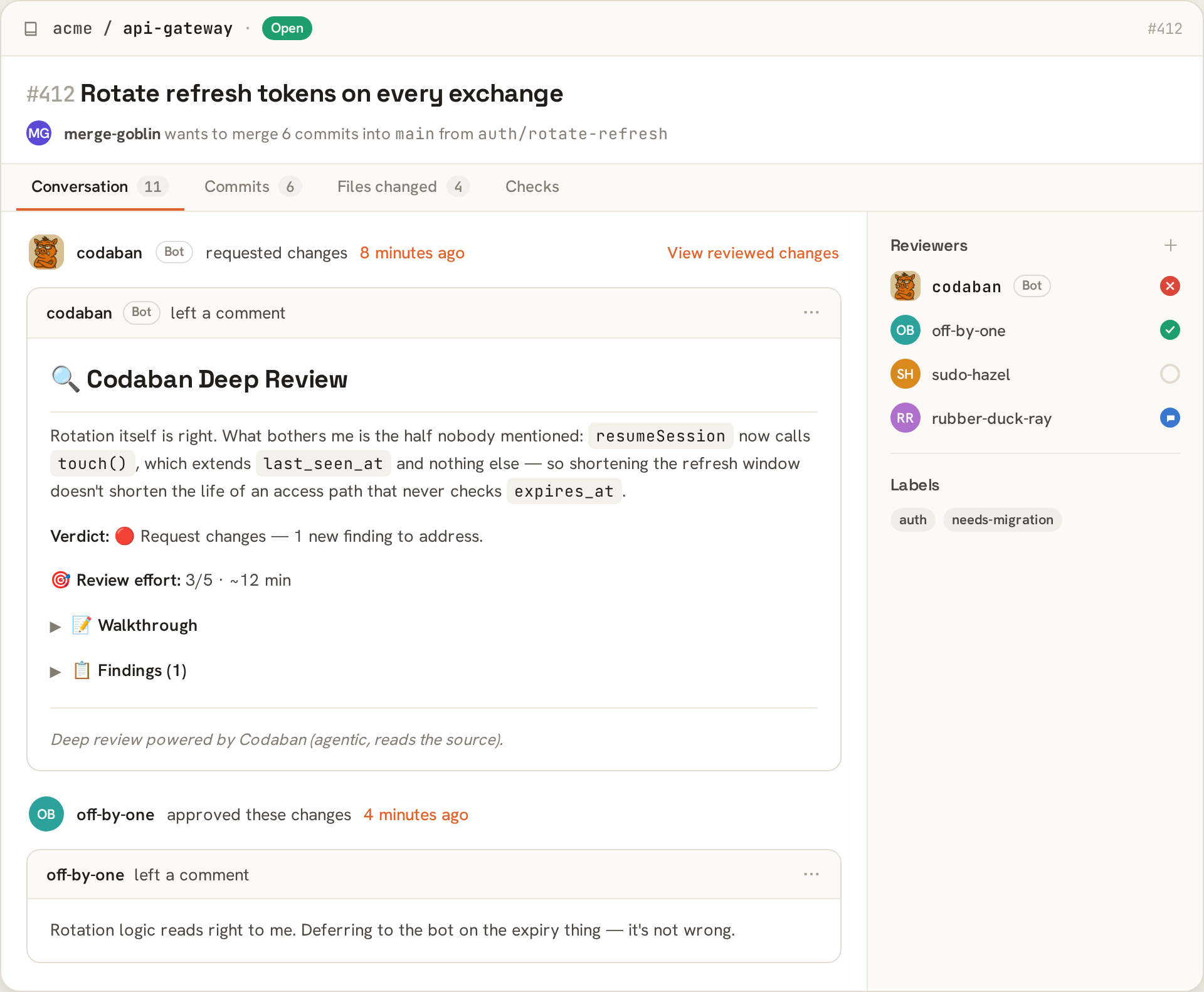
Codaban in the reviewer list, with the same outcomes as everyone else.
Smoke review
The quick one. It reads the diff and nothing else — it never opens the rest of the repository, so it can’t tell you whether your change breaks something three files away. Use it for typos, obvious mistakes, and a sanity check before you ask for the real thing. It is not a real review, and it isn’t pretending to be one. Mechanically: it fetches the diff, annotates it with line markers, and asks the senior model tier for findings. Those findings are then self-critiqued by the junior tier — stylistic and speculative ones get retracted before anything is posted. The result is one PR review carrying:- a verdict,
- a summary,
- inline comments anchored to the changed lines, each with an optional suggestion and a copy-pasteable “Prompt for AI” block. When the fix is a clean drop-in for the commented line, the suggestion renders as a one-click committable block on both GitHub and Forgejo — review the diff it shows, then commit it without leaving the PR.
Reading a finding
Every inline finding leads with a header you can triage without reading the prose — category · severity · effort, for example🎯 Correctness | 🔴 Critical | ⚡ Quick win:
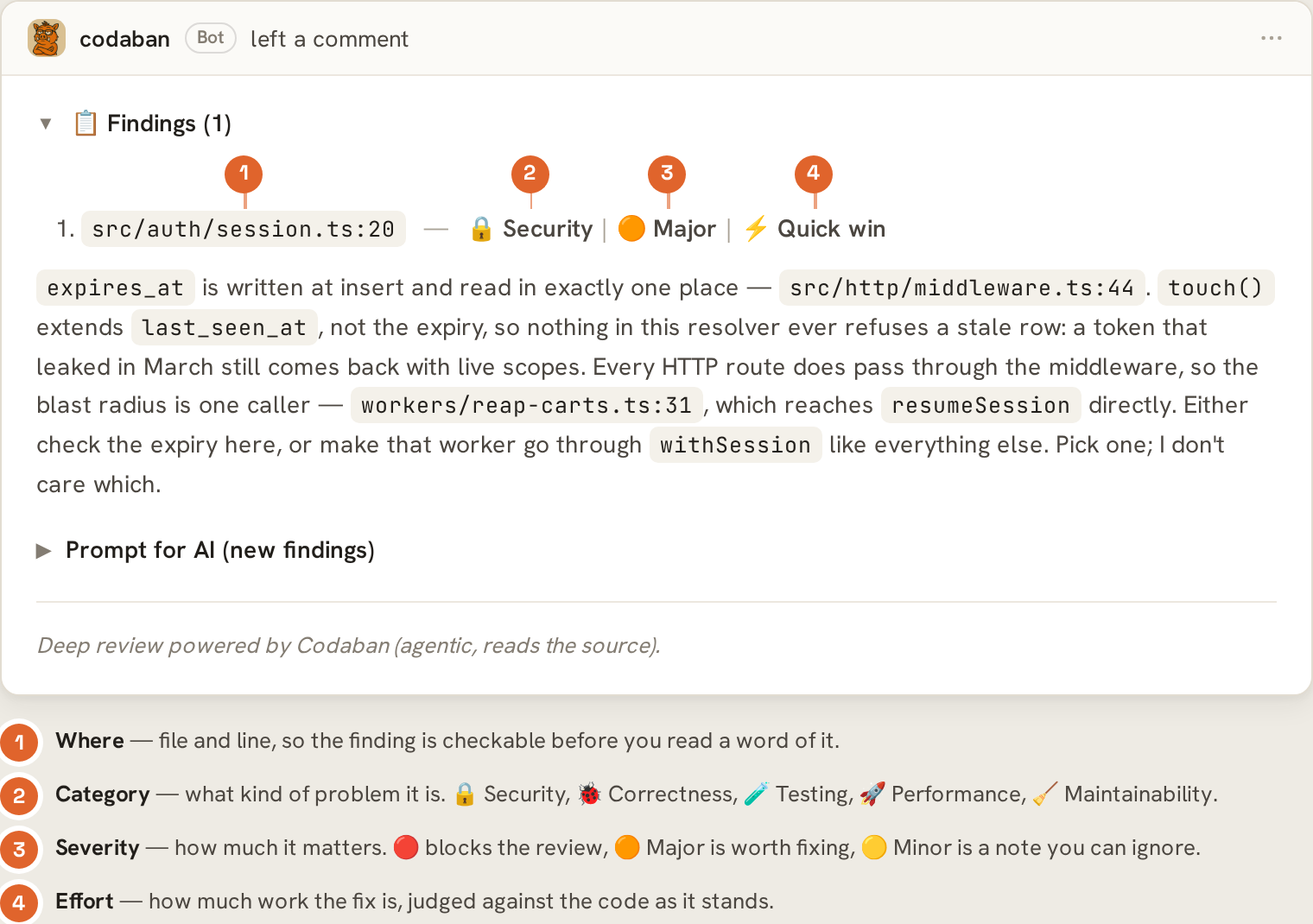
One finding, with its four header segments called out.
- Category — Correctness, Security, Performance, Maintainability, Reliability, Style, Testing, or Docs.
- Severity — 🔴 Critical, 🟠 Major, or 🟡 Minor.
- Effort — ⚡ Quick win (small, bounded fix), 👍 Worth it (real but clear work), or 🔹 Nitpick (optional polish).
🔍 Unverified appears when Codaban could not confirm the finding from the
code alone. It can read the repository but never run it, so runtime output,
external specs, and “does this test pass” are out of reach.Treat it as a question worth checking, not a verdict — the finding usually
names the command that would settle it. These never rank above 🟠 Major,
never request changes on their own, and a later review may repeat one but
won’t build a new finding on top of it until it’s confirmed. A confirmed
problem alongside one still blocks.
Re-reviews
When Codaban has reviewed the PR before, a new run becomes a three-phase pipeline instead of a naive second pass:1
Resolution check
The diff since the last review is compared against the previous
findings, and fixed ones are marked resolved.
2
Fresh review
The full diff is reviewed clean-slate.
3
Self-critique and dedup
New findings are challenged, and anything already reported — or explained by
you in a thread reply — is filtered out.
Deep review
The real review, and what runs by default. Codaban checks out the PR branch and runs a coding agent in read-only mode against the working tree. It reads source beyond the diff, follows references, and verifies findings against actual code — which is what lets it catch the thing your change broke somewhere else. It can also resolve or retract its previous findings: it reacts on the thread (🎉 resolved, 👀 retracted), and on GitHub also edits the finding’s comment to mark it✅ Addressed in commit <sha>. Its status comment carries a collapsed
per-file Walkthrough table and a Review effort estimate alongside the
verdict.
Deep review defaults to the middle model tier. Label the PR senior to escalate
— see Labels.
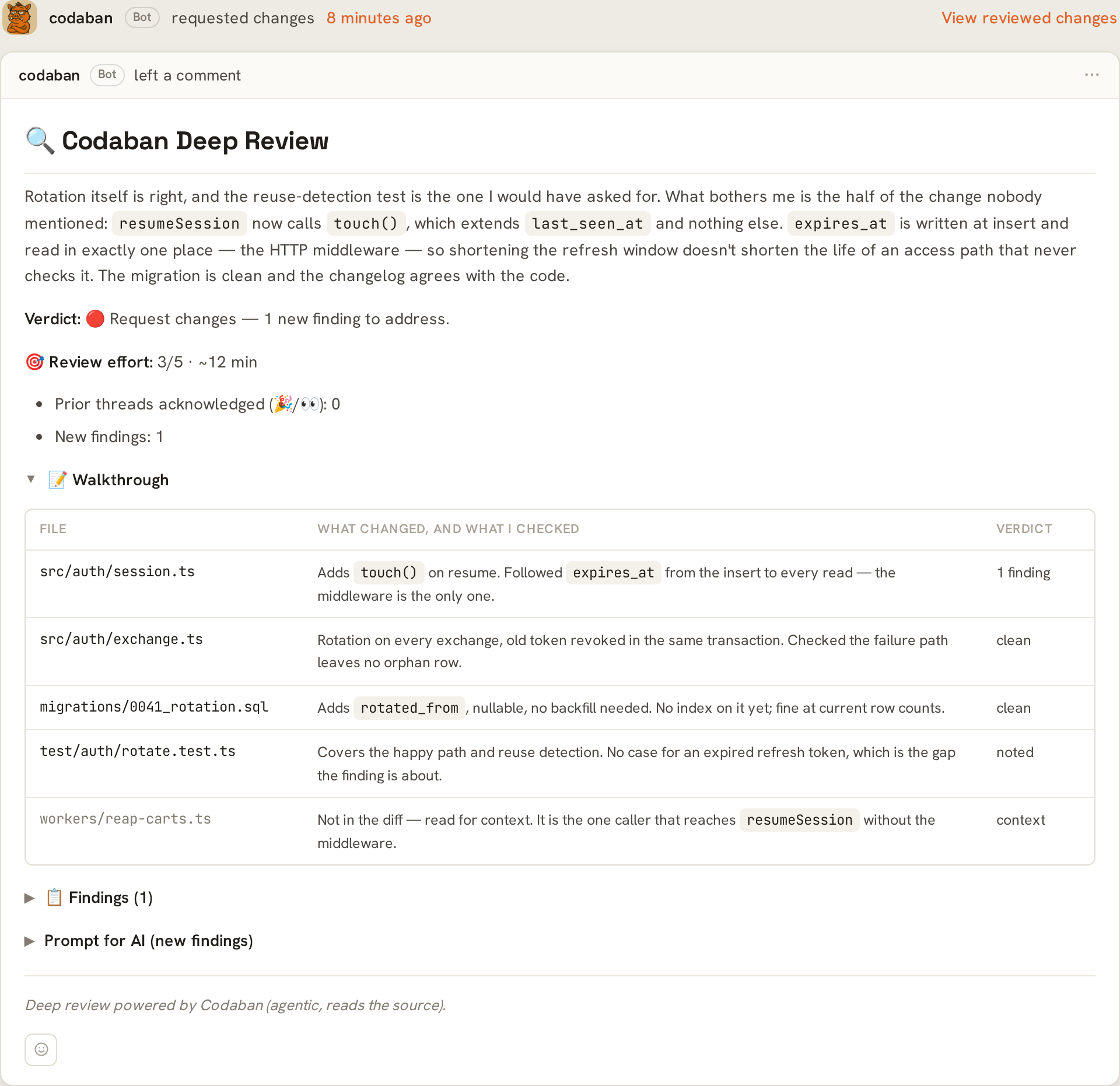
A deep review's status comment, Walkthrough expanded.
How the verdict is decided
Severity-aware. A new error or warning finding requests changes — that is the floor. When nothing blocks, the model renders its own verdict, and a kept nitpick stays non-blocking. Without an explicit verdict the count-based rule applies: anything new, or any kept thread, requests changes. Otherwise it approves. A clean pass approves either way. One finding can opt out of the floor. A real issue the reviewer agrees to let ship — a tracked follow-up, or a constraint you named and it accepted — is marked accepted and posts at its real severity without gating the merge. So a review whose prose says it’s allowing the PR now actually approves it, instead of blocking over its own tracked notes. Anything it genuinely wants fixed still requests changes.PR description upkeep
Every review run — smoke or deep — also refreshes the PR description. A generated Summary section is appended under a🐗 Auto-generated by Codaban
marker. Your own text is preserved verbatim, and re-runs replace the generated
section instead of stacking copies.
Triggers by forge
Auto-review is on by default, in deep mode, so a new pull request gets a
real review without anyone asking. Change the mode per repo, or turn it off
per workspace, in Settings → Auto-review.
@codaban stop review disables
it for a single PR.
Talking to Codaban about findings
Reply to any inline finding and Codaban answers in the same thread — explaining the reasoning, taking your point, or holding its ground. If your reply convinces it, or you explain why the code is deliberate, the finding counts as resolved in the next re-review’s dedup phase.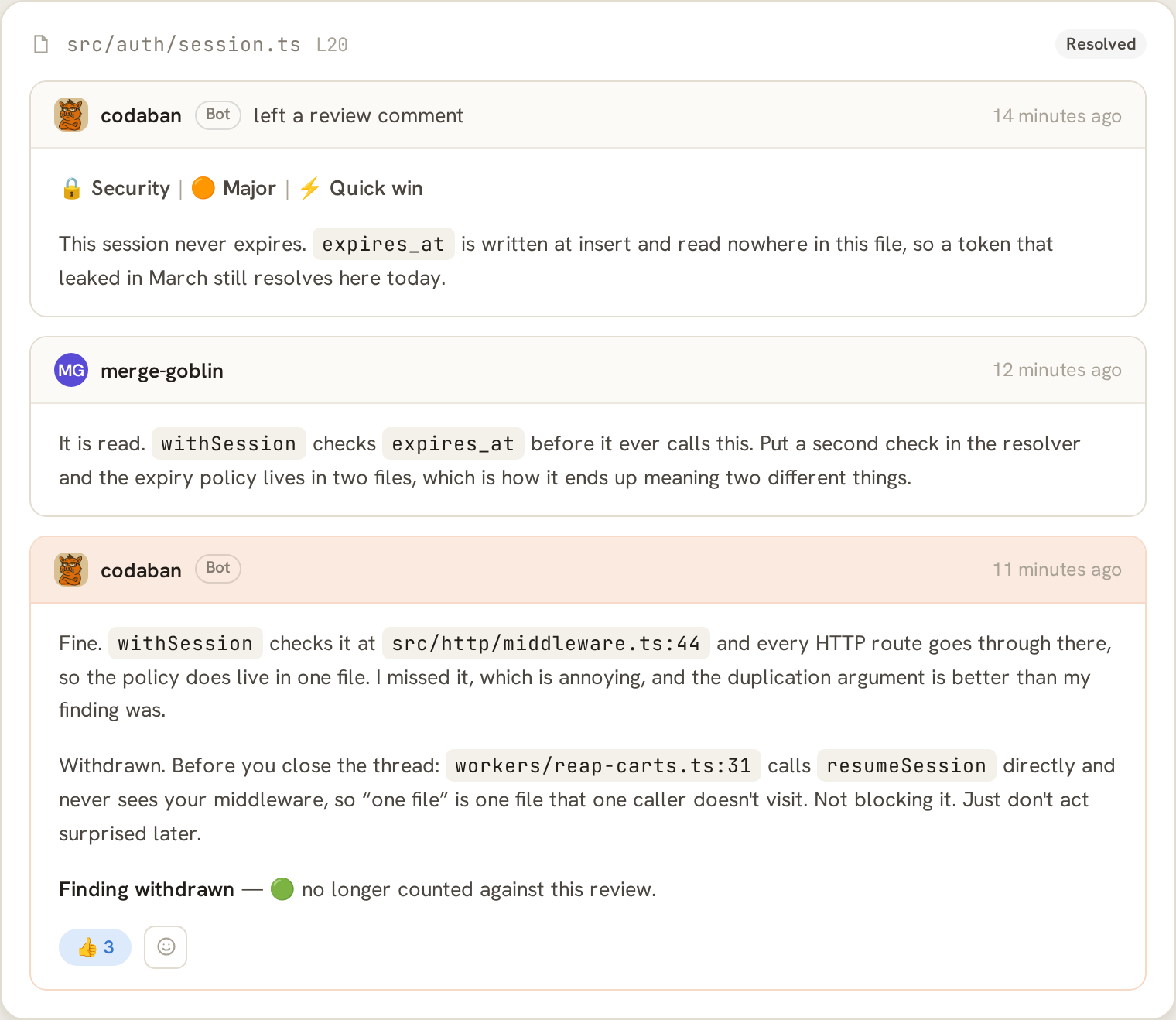
Pushback, and a withdrawn finding.
Tell me why I’m wrong. If you’re right I’ll drop it — and I won’t bring it up
again next review.