

One number that matters: reviews left this month. No token math, no surprise
invoice, and no cost anxiety for your team.
Billing accounts
A billing account is owned by a user and answers “how is this work paid”. A workspace points at one account, and the usage meter pools per account — so one bill per person, across every workspace that account funds. Each user has one default account. You can create more (say, Personal versus Client’s own key) and choose which funds each workspace. An account is one of:
Precedence is BYOK → plan → trial → inert. Once you’re paying, unspent trial
units stop mattering and the plan’s pool is what counts.
BYOK is not a plan. An account is BYOK simply by having its own key
attached. There is no “BYOK plan” in the catalog.
The free trial grant
Every billing account is created with 10 free review units, so you can watch Codaban review real pull requests before being asked to pay. It differs from a plan’s pool in one important way: it never refills. A plan’s pool resets on the 1st of the month. The grant is spent once, and that is that. Spending the last unit gets its own reply on the PR — “that was the last of your 10 free reviews” — rather than a generic unfunded notice.Plans
Every plan is the same product: all engines, unlimited seats, unlimited repositories, no throttling. A plan only sets the monthly review-unit pool and its price.
Pick the one that matches how much you ship, and switch whenever that changes.
Nothing above is final — it’s our current thinking. Codaban is in closed beta,
the numbers will move before launch, and beta teams keep founder pricing
regardless. Tell us if the model is wrong.
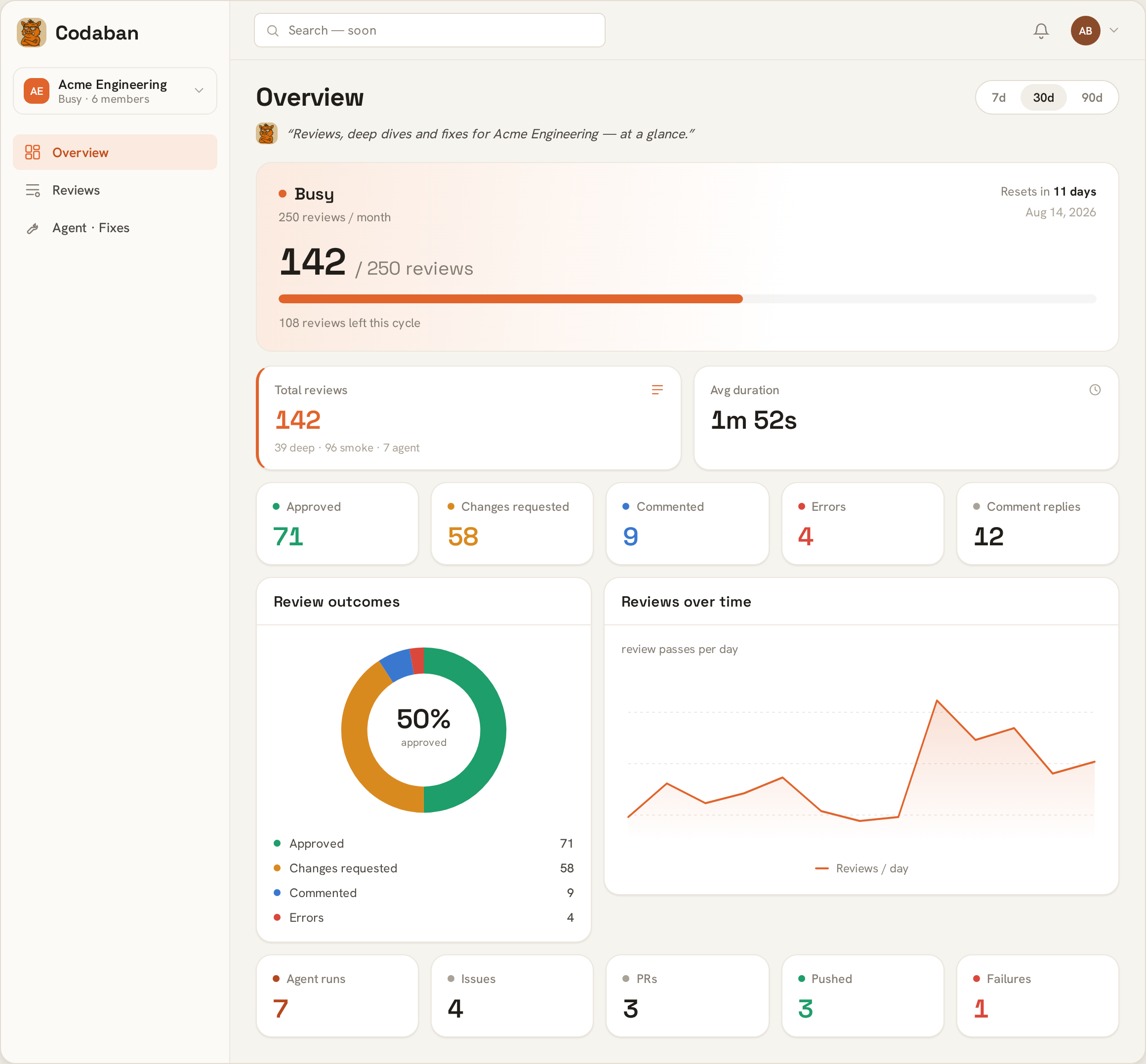
The Overview page — plan, pooled counter, reset date, and the mode split.
Units
One dispatched review or fix is 1 unit, whichever mode you use. A smoke review, a deep review, and each agent-fix run — plan, implement, iterate, including the GitHub fix-checkbox and a trace-page re-run — all count 1. The pool resets on the 1st of each calendar month (UTC), automatically.The two gates
Every job passes two checks before it runs:1
Billing gate
The workspace’s funding account must be runnable: metered with a plan,
BYOK with its own key, or trial with an unspent grant. An unfunded
account is off. This also picks which key the job runs on.
2
Units gate
A metered account is hard-blocked once its monthly pool is spent, and a
trial account once its grant is. BYOK skips the cap.
@codaban review, deep review, or
fix command gets a reply — a “set up billing” note when it’s unfunded, a “limit
reached, move to a bigger plan” when a metered pool is spent. A passive or
automatic trigger skips silently.
The units gate fails open on infrastructure errors, so a transient blip
never blocks a paying user.
Bring your own key
Attach your own LLM key under Account → Billing, per account. That makes the account BYOK: uncapped, billed by your provider, no plan needed. Point a workspace at that account under its Settings → Billing. Your key is encrypted at rest and never returned by the API — you see the endpoint and the last four digits only.What you see
Members, including workspace owners, see units, never dollars. For a BYOK account that’s correct: your real bill lives on your own provider account, not in Codaban’s estimate. Token counts follow the payer. A BYOK workspace does see the token totals on its reviews — it’s paying the provider for them — while a metered workspace sees units instead, since the tokens are only the input to a price it isn’t charged.Traces
Opening a review shows every member what it did: the passes, their verdicts, what each one found, how long it took — and for a deep review, an expandable story of Codaban’s own narration interleaved with what it did (“read a few files · 3”, “inspected git history · 2”). The same holds for an agent fix: opening an issue from Agent · Fixes shows every member its runs, which phase each was, whether it landed or failed, and how long it took. What stays operator-only is the machine underneath — the review prompt, the exact commands and their output, per-turn model and token detail, and the raw session download.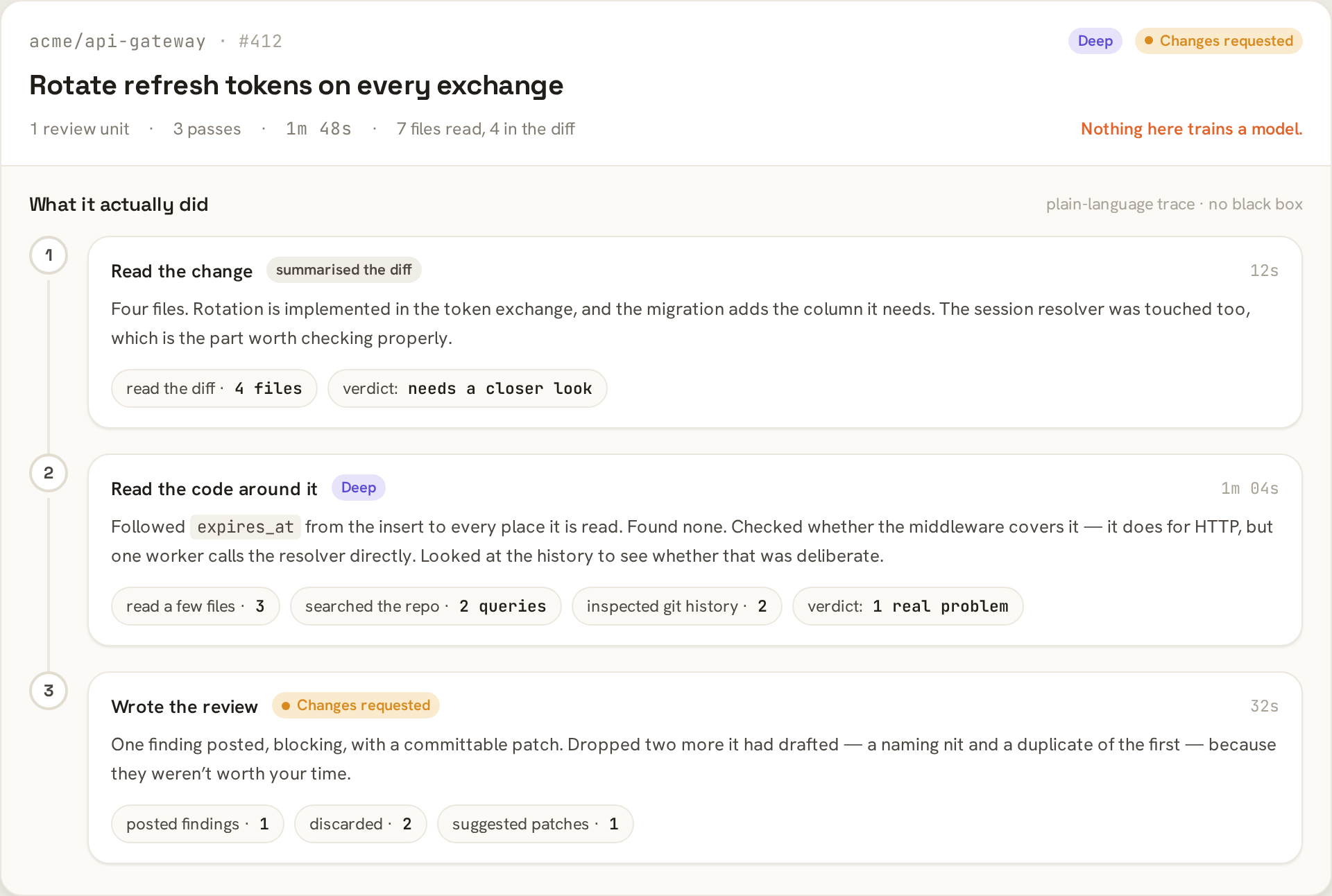
What one review unit actually did, pass by pass.
Every prompt I sent, every file I opened. If I got it wrong, you’ll see
exactly where.