

@codaban
comments on the issue — the same model as the review commands.
I don’t trust my own first draft. So I review it like someone else wrote it.
Available on both Forgejo and GitHub. On GitHub the runner works with
short-lived per-installation tokens and commits are attributed to the App bot
(
codaban[bot]).This flow used to be driven by plan / todo labels. It is now
comment-driven — applying those labels does nothing. Each command is one
deliberate run, one explicit spend. An optional fast / standard / smart
tier rides any verb.Plan
Comment@codaban plan on an issue. Codaban spins up an isolated runner
with the repo checked out, studies the codebase read-only — it cannot write,
commit, or push — and posts the implementation plan as an issue comment. The
plan ends with a next-steps line telling you how to proceed.
- After planning, Codaban suggests a model tier for the implementation by
labeling the issue
junior/middle/senior— unless you already set one, or named a tier on the command. Your choice always wins. - Want changes to the plan? Reply on the issue with your corrections, then
@codaban implement— your follow-up comments are folded into the implementation prompt as higher-priority guidance and override the plan where they conflict. Or just re-run@codaban plan.
Implement
Comment@codaban implement with the plan comment in place, and Codaban:
1
Creates a branch
Named
{change-type}/{issue}-{slug} — change type from the issue’s feat /
fix / … label, chore by default.2
Implements the plan
All git operations are scripted. The coding agent never touches git itself,
so it can’t invent branches or commits.
3
Opens a PR
With a generated description, linked to the issue so it auto-closes on
merge, and tagged with the change-type label (created on demand).
@codaban handle chains plan → implement without waiting for
your approval. If the plan finds the work is already done — it reads the
working tree — handle stops there and posts a single ”✅ Already resolved —
nothing to do” note instead of spending a second run to report no changes.
@codaban implement without a plan comment falls back to implementing straight
from the issue description. That’s a slower first pass, and empty issues get a
polite error comment instead.
Iterate
Review the bot’s PR like any other. Codaban iterates when:- you comment
@codaban iterate(aliasaddress) on its PR — the explicit form, on both Forgejo and GitHub, or - (GitHub) you tick a ”🔧 Fix this” or “Fix all findings” checkbox on a review finding, or
- you submit a review requesting changes on its PR.
What does not trigger a commit. A plain reply on one of Codaban’s review
threads is conversation — Codaban replies but pushes nothing. A plain
top-level PR comment does nothing at all: no reply, no commit. Assigning the
bot to a PR doesn’t trigger it either.Earlier versions auto-fired the fixer on any comment or assignment, which
surprised people by rewriting code on ordinary chatter.
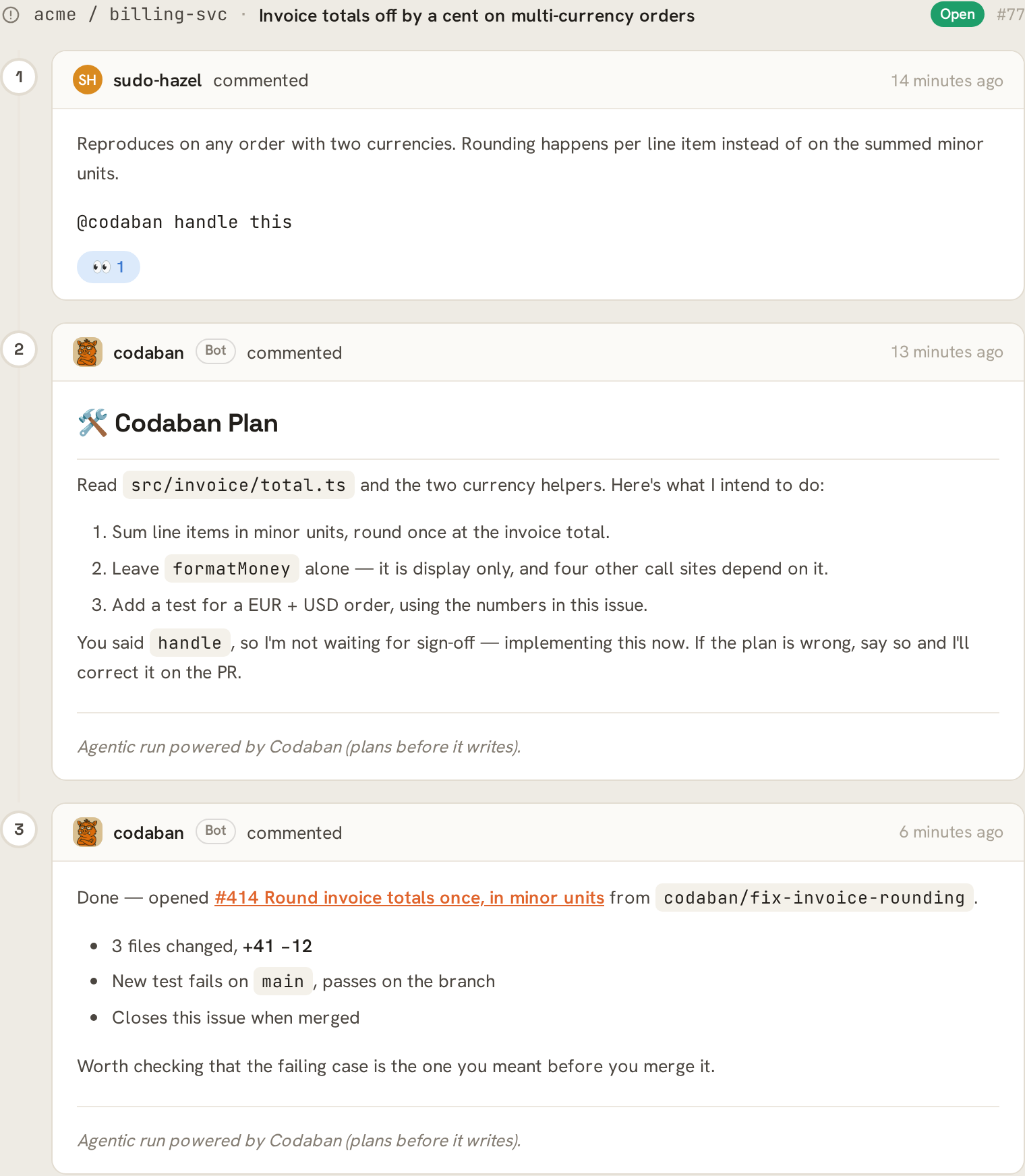
One issue, end to end: the ask, the plan, the pull request.